
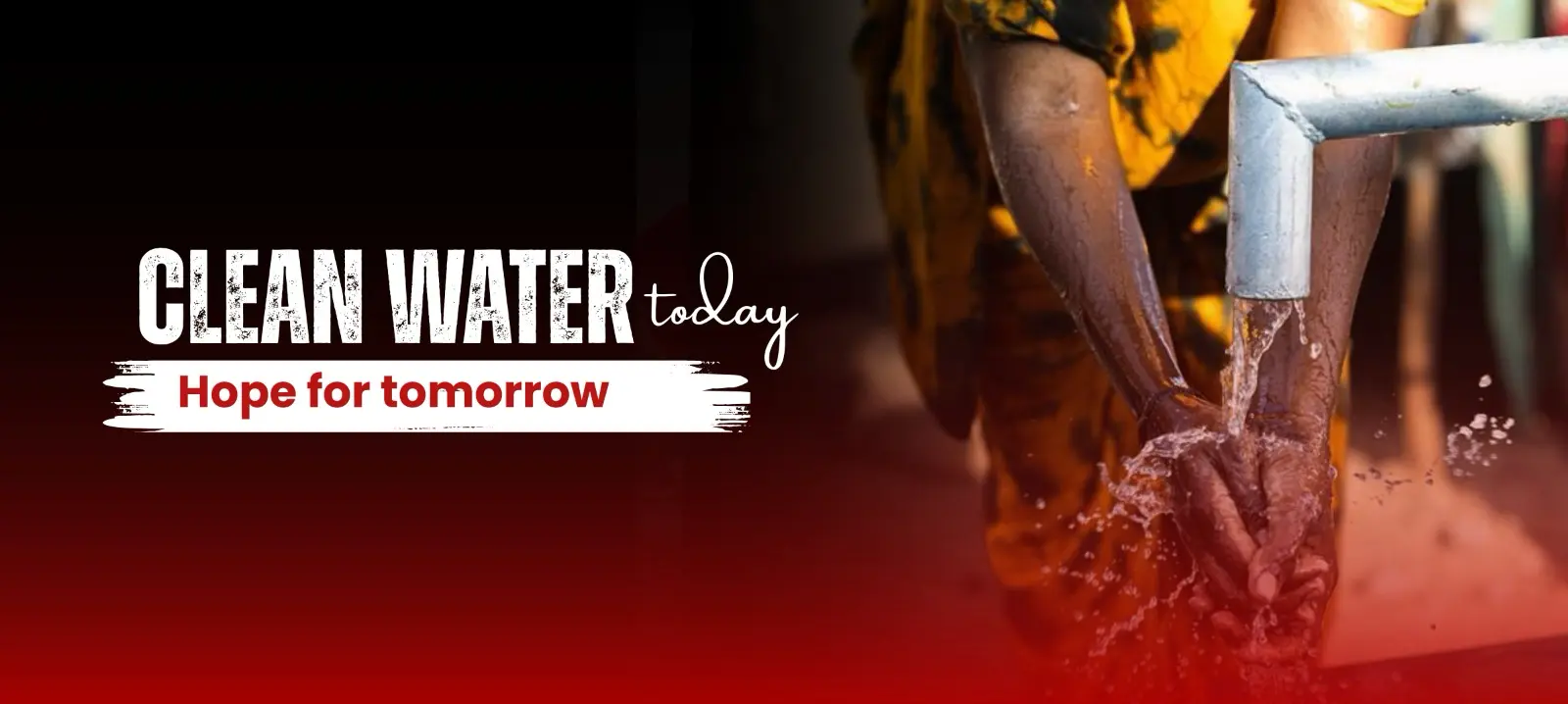
Nearly 2.1 billion people wake up without access to safe drinking water. Every day, waterborne disease claims thousands of lives, most of them children. For many, access to safe water, sanitation, and hygiene is not a given. It is the difference between life and loss.
HCI’s WASH program is changing that. One well, one school, one family at a time.
“The best charity is giving water to drink.”
- The Prophet ﷺ | Sunan Ibn Majah, 3684
Across Sub-Saharan Africa, South Asia, and the Middle East, entire communities are forced to drink from contaminated rivers, walk hours to collect water, and open-defecate in the absence of basic sanitation. Women and girls bear the heaviest burden, spending hours daily on water collection instead of school or economic participation.
Unsafe water, poor sanitation, and inadequate hygiene account for approximately 80% of all disease in the developing world. These diseases then lead to loss of schooling and income, and traps communities in cycles of risk and vulnerability. Waterborne illnesses like cholera, typhoid, and dysentery are not inevitable, they are preventable. The solution is within reach.
Disclaimer: HCI build wells where there is greatest need. At HCI we understand donor preferences for specific countries. However, we cannot always guarantee project locations. Our approach enables us to reach the most vulnerable communities, providing a foundation for better health, stronger livelihoods, and a pathway from crisis to sustainability.
$100
Provide clean water to a family
$500
Provide clean water to five families
$1,500
Build a well in Asia
$3,000
Contribute to a WASH facility for a community of 5,000+ individuals
$5,000
Build a well in Africa
The scale of the crisis, by the numbers (Source: WHO)
Through emergency response and long-term infrastructure, HCI has reached communities facing extreme water and sanitation insecurity across Asia, Africa, and the Middle East. Every project, every well dug, every water station set up, every school that now has clean running water, is a direct result of your generosity.
Behind each figure is a child drinking clean water, a school that can stay open, and a family feeling safer each day.
Water, sanitation and hygiene, collectively known as WASH, are among the most powerful determinants of human health and dignity. When a community gains access to clean water and safe sanitation, almost everything else improves with it: health outcomes, school attendance, economic productivity, and the safety of women and girls. When they don’t have it, the consequences reach far beyond thirst.
The WHO estimates that unsafe water, sanitation and hygiene causes at least 1.4 million preventable deaths every year. More than a million of those deaths come from diarrhoeal disease alone, and the vast majority are children under five.
One in five children worldwide lack basic drinking water at their school. Girls are disproportionately affected: without proper sanitation facilities, many are pulled from school entirely, not due to lack of ambition, but because the basic conditions for safety and dignity simply aren’t there.
Collecting water, often over long distances, falls largely on women and girls, consuming hours that could be spent in school or work. Poor water and sanitation conditions drive chronic illness, lower productivity, and keep families locked in poverty across generations.
At Kodai No. 1 Public School in Charsadda, Pakistan, nearly 900 students and staff relied on a shallow, seasonal hand pump for all their water and hygiene needs. During peak summer months, the pump ran dry. Water testing later confirmed bacterial contamination, the children were drinking water that was actively making them ill, with nothing adequate for sanitation or daily use.
Imagine being a teacher trying to run a classroom while your students are sick. Imagine being a parent who sends their child to school, trusting it is safe, and it isn’t. That was the reality at Kodai before HCI intervened.
Following a comprehensive needs assessment, HCI installed a 120-foot solar-powered borewell, complete with a pump and storage system. It operates independently of the electricity grid – clean water, every day, every season, without interruption.
Roughly 900 people, including students, teachers, and school administrators, now have reliable access to safe, clean water every day. Attendance has stabilised. Health outcomes have improved. The school can focus on education rather than crisis management.
This is what happens when humanitarian aid invests in sustainable water, sanitation and hygiene infrastructure, not just emergency relief, but the kind of change that lasts.
Your support can become Sadaqah Jariyah, a continuous charity that keeps giving long after the donation is made. Every well dug, every water station built, every family reached with safe water, sanitation and hygiene support, these are not one-time acts. They are investments that ripple through communities for years, even generations.
“When a man dies, his deeds come to an end except for three: ongoing charity, beneficial knowledge, or a righteous child who prays for him.”
The Prophet ﷺ | Sahih Muslim
A water well you fund today may be drawing clean water for a family fifteen years from now. That is the weight of what your giving can carry
Access to clean water, sanitation and hygiene is one of the highest-impact humanitarian interventions available. The return on investment isn’t measured in dollars, it’s measured in children who grow up healthy, in girls who stay in school, in families who stop losing income to preventable illness.
At HCI, we believe every family deserves to live without the fear of contaminated water. That every child deserves to grow up without losing months of schooling to preventable illness. That every woman and girl deserves the safety and dignity that proper sanitation provides. Your support makes this not just possible, it makes it real.
Preventing suffering is not only possible, it is urgent, measurable, and among the most meaningful acts of giving that exists.
While donors may indicate a preference (Asia or Africa), wells are built where the need is greatest. You’re welcome to share your preference by email at [email protected], and HCI will do its best to accommodate requests where possible.
Yes. You may include an inscription of up to 25 characters, a wonderful way to dedicate the well to a loved one or as Sadaqah Jariyah on someone’s behalf. Please share your donation receipt and inscription via email.
Construction typically takes 6-8 months, excluding pre- and post-construction phases. External factors such as weather, terrain, or local conditions may affect timelines.
Yes. Donors receive photos, and in many cases short videos, of the well both during and after construction, so you can see the impact of your gift firsthand.
Shallow wells with hand pumps typically last 8-15 years, depending on usage, maintenance, and local conditions. Solar-powered borewells are designed to last even longer.